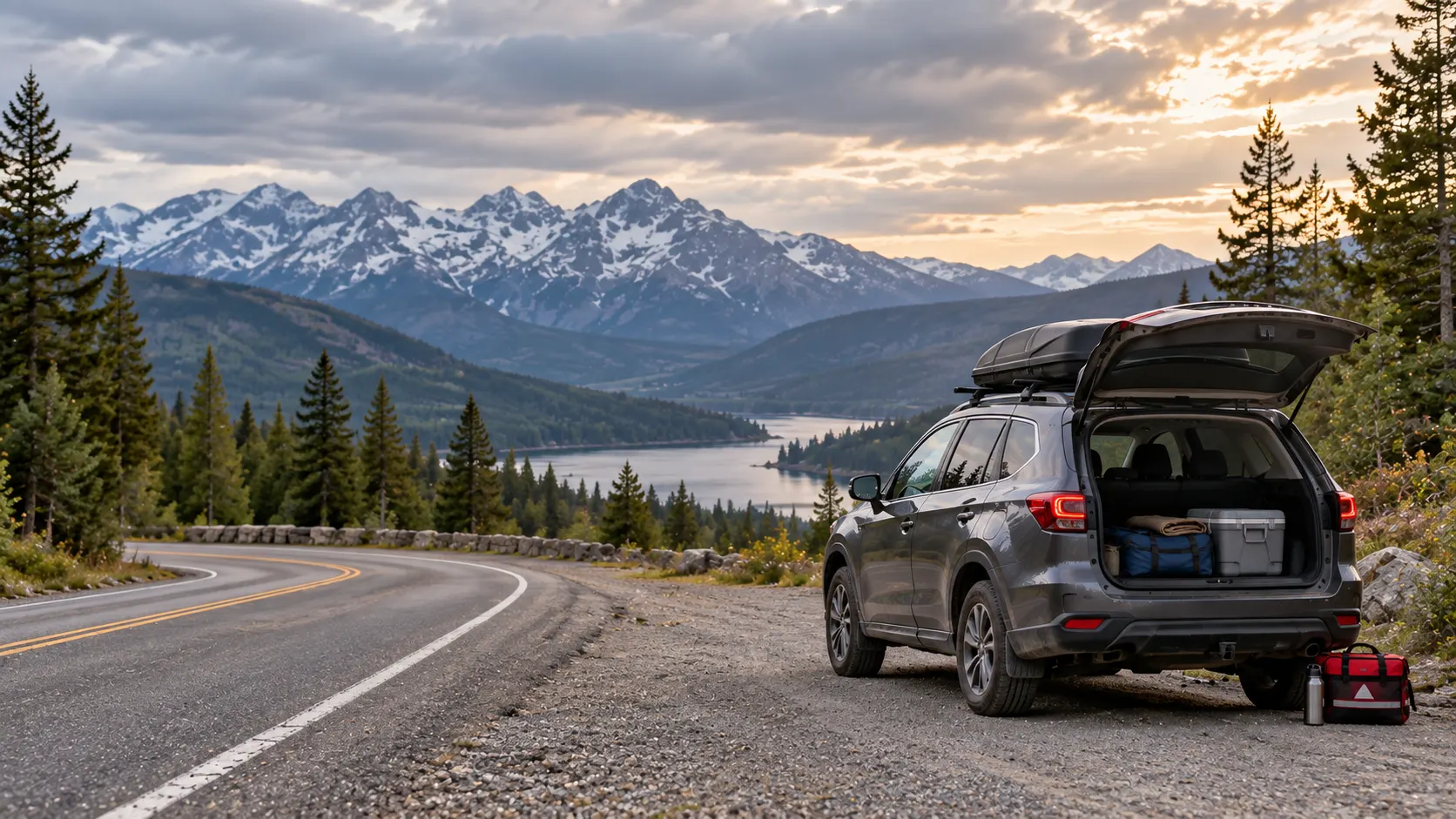
What should I keep in my car in case I get stranded?
Build for the problems that actually strand people: dead battery, low tire, no phone power, darkness, heat or cold, minor injury and waiting longer than expected for help.
Before you buy anything: check the car
Find out what your vehicle actually came with. Locate the spare tire or factory sealant kit, jack and lug wrench. Check that the spare is properly inflated, that the sealant has not expired, and that you have the wheel-lock key if your wheels use locking lug nuts.
Do this in the driveway once, not for the first time on the shoulder of a highway. Your owner's manual shows the vehicle's approved jacking points and tire-change procedure.
Dead battery: two good choices
This is the jump starter we keep in our own car and personally love. It is compact enough to stay in the vehicle, which matters because emergency gear only helps when it is actually with you.
GOOLOO rates the GP2000 at 2,000A peak for 12V vehicles with gas engines up to 8.0L or diesel engines up to 6.0L. It also works as a USB power bank and has a built-in emergency light.
Buy the exact GOOLOO GP2000 →See it at GOOLOO →A compact 1,000A jump starter for typical passenger vehicles, with spark-proof and reverse-polarity protection. NOCO has the stronger long-established name, but it usually costs more, so we would not make it the only choice.
Buy the exact NOCO GB40 →Low tire: our favorite separate inflator
This is the kind of gadget that earns its trunk space. It is cordless, USB-C rechargeable, shows current and target pressure, and automatically stops at the PSI you set. Fanttik rates it to 150 PSI, with up to 40 minutes of runtime, an LED light and USB output that can provide emergency phone power.
Why we prefer this for most people: you do not need to drag a cord through the car or watch a pressure gauge while filling. Set the vehicle's correct cold-tire PSI, connect it and let auto-stop do the work.
Buy Fanttik X8 APEX on Amazon →See manufacturer details →Two tiny things that could matter a lot
A spring-loaded tempered-glass breaker plus protected seatbelt cutter small enough to keep within reach instead of buried in the trunk. Important: many newer vehicles use laminated side glass, which a small breaker may not shatter. Check your own window markings before relying on any escape tool.
Buy resqme 2-pack on Amazon →See manufacturer details →No battery, almost no space, and far easier than yelling continuously if you need to attract attention. Keep it accessible, not at the bottom of the emergency bag.
See Fox 40 Classic →Finish the kit
USB-C rechargeable CORE battery plus the ability to run on three standard AAA batteries gives you two power paths.
Buy ACTIK CORE →Passive reflectors do not depend on another battery being charged when you need them.
Buy CARTMAN triangles →Compact and waterproof with useful wound-care basics. Add personal medications and household-specific supplies.
Buy AMK .7 →A backup wind/water-resistant warmth layer and high-visibility signal surface, not a substitute for proper winter clothing.
Buy SOL blanket →Seasonal layer: change the kit when the weather changes
Cold/snow: add a real blanket or sleeping bag, warm hat, gloves, extra socks or warm layers, ice scraper/snow brush, compact shovel and a traction aid such as sand or non-clumping cat litter when snow or ice is realistic where you travel.
Heat: carry substantially more fresh drinking water when traveling in hot weather. Do not rely on the emergency pouches below as your normal supply for a long hot-weather delay.
The point is not to haul winter equipment all year. Adjust the car kit for your climate, season and route.
Food + water
Keep shelf-stable food you will actually eat and rotate it. Nature Valley Oats 'n Honey bars are individually wrapped and do not have a chocolate coating to melt.
Buy Oats 'n Honey bars →These are exactly the kind of foil emergency-water pouches that make sense in a vehicle. Each sealed pouch holds 4.2 oz of triple-purified water, has a five-year shelf life, and the manufacturer rates the pouch for temperatures from -22°F to 149°F. They are U.S. Coast Guard approved and designed specifically for emergency storage.
Why pouches instead of ordinary bottles: cars experience freezing winters and extremely hot interiors. These multi-layer foil pouches are designed for a much wider storage-temperature range than ordinary bottled water and take very little space. Keep several as the reserve you can leave in the vehicle, then bring normal fresh drinking water for everyday use.
Important: temperature tolerance does not mean you should intentionally heat or boil the sealed pouch. It means the unopened package is designed to survive the temperature swings that can happen in a stored emergency kit. Discard any pouch that leaks, swells, punctures or has passed its marked expiration date.
See SOS emergency water →Navigation when the network disappears
Keep one detailed offline map downloaded on your phone and one paper map in the vehicle. Download the route and surrounding region before trips outside your normal area. Your phone's GPS may still know where you are without cell service, but it cannot display map data that was never downloaded.
Get free offline + printable maps →Remote travel: when your phone has no bars
If you drive, camp or travel somewhere cell service can disappear, this is the communication upgrade that matters. Pair ZOLEO with your phone and you can send and receive two-way text, email and app messages through the Iridium satellite network when cellular service and Wi-Fi are unavailable.
What that means if you are stranded: with an active ZOLEO service plan and a clear enough view of the sky, you can still message someone that you are stuck, explain what happened and share your location instead of staring at a phone that says SOS or No Service. ZOLEO also has 24/7 monitored SOS and GPS location sharing.
Your phone does not have to be your only lifeline: the physical ZOLEO device has dedicated SOS and Check-In buttons. Even if your phone is dead or damaged, you can press Check-In to send your chosen contacts an “I'm OK” message with your location, or activate SOS in an emergency. Full two-way messaging uses the paired ZOLEO app.
Know before you buy: satellite messaging requires an active service plan and works best with a clear view of the sky. Terrain, buildings, heavy tree cover and other conditions can affect satellite connectivity.
Buy ZOLEO →See how ZOLEO works →Keep this in the glove box
Paper still works when electronics do not. Keep emergency contacts, roadside-assistance information, insurance/registration information and a pen where you can reach them. A small amount of emergency cash can also matter if a regional outage takes card readers or ATMs offline.
If you are traveling somewhere unfamiliar, put the paper map here or somewhere equally accessible rather than under everything in the trunk.
See the coolest useful emergency gadgets →